by Caroline Leach | Aug 3, 2026 | Careers, Communication, Leadership

I thought I was teaching my students this year.
Turns out, they were teaching me.
Congratulations to the USC graduates who celebrated commencement this spring!
This milestone lends itself to advice I might give to the graduates.
Instead, I’ve been reflecting on what I learned from my students this year in the USC MS in Digital Media Management at the Annenberg School for Communication and Journalism.
One lesson came through again and again:
Speak up.
In my Digital Media Leadership class, I started each session with a roll call question tied to the week’s topic. (Hat tip to program director Joseph Itaya.)
So many hands went up that roll call practically ran itself.
The students showed incredible initiative. They spoke up. And it changed the energy of our class every week.
They spoke up in discussions.
In breakout sessions and presentations.
In thoughtful discussions in class.
And in the messages some of them wrote to me at the end of the semester, which I added to a happy file I keep for difficult days.
One message in particular stayed with me.
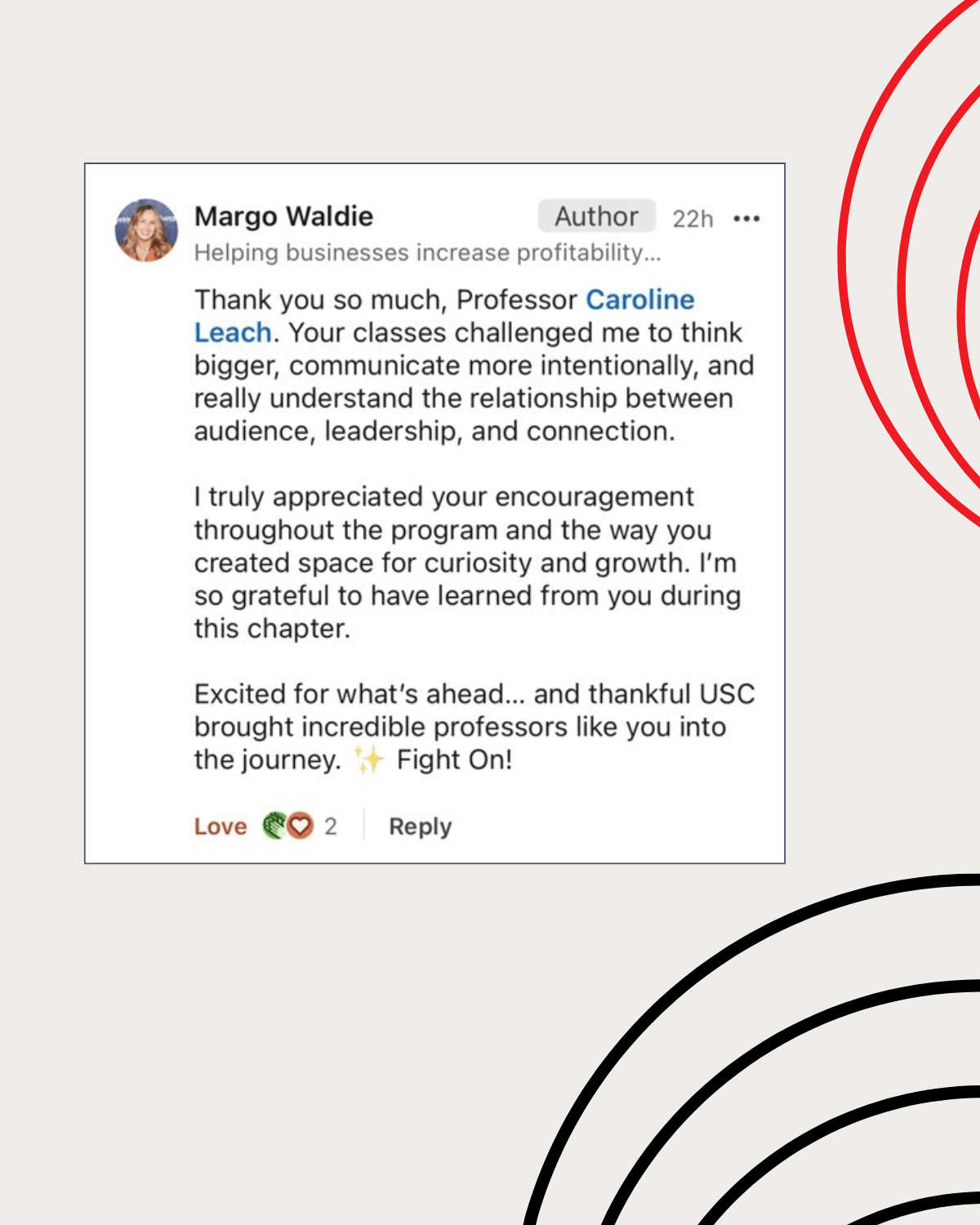
A student replied to my comment on her LinkedIn graduation post with words so thoughtful they made my week. Maybe even my whole year.
Thank you, Margo Waldie.
My biggest takeaway from this year:
Speaking up is more than participation.
It’s leadership.
What’s something a younger colleague or student taught you this year?
by Caroline Leach | Jul 13, 2026 | Communication, Leadership

Waiting to feel ready is costing you more than you think.
Especially when it matters most.
Years ago, an EVP asked for my thoughts on a communications issue.
I said I’d think about it and follow up.
Fair, right?
After the meeting, my manager pulled me aside.
“When a senior leader asks you a question, they expect a point of view in the moment.”
That stuck.
Because waiting has a cost:
1. You don’t come across as strategic
2. You get overlooked for bigger opportunities
3. And the team misses what you could have added
So why do we hold back?
↳ We second-guess our thinking
↳ We don’t have a perfect answer
↳ We assume everyone else is more certain than we are
(They’re not.)
Here’s what works instead:
Say this:
“Based on what you’ve shared, my initial thought is we should … .”
Add a relevant example.
Then close with:
“I’ll follow up with more detail this afternoon.”
You don’t need a perfect answer.
You need a point of view.
What do you say when you don’t have a fully formed answer?
by Caroline Leach | Jul 1, 2026 | Communication, Leadership

Most updates tell you what happened.
Very few explain why it matters.
Wrapping up spring semester teaching at the USC Annenberg School for Communication and Journalism brought this back again.
In strategic planning, everything comes down to one question:
What problem are we solving?
That’s where most updates fall short.
An operational update sounds like this:
“We launched the campaign, finalized the assets, and engagement is up 12% week over week.”
Clear. Efficient.
And incomplete.
A strategic update sounds like this:
“We’re addressing a drop in engagement among busy parents of children under 10. The campaign launched last week is designed to re-engage that group. Early signals are encouraging, with engagement up 12% week over week.”
Same work.
Different level of thinking.
The shift:
From activity → PURPOSE
From reporting → INTERPRETATION
From what happened → WHY IT MATTERS
If you want to be seen as more strategic, start here:
Anchor every update in the problem you’re solving. And how your work moves it forward.
Try this on your next update:
How is your latest work actually addressing the problem?


Recent Comments