by Caroline Leach | Aug 5, 2026 | Careers, Communication, Executive Communication, Leadership

Most people communicate worse under pressure.
Not because they lack expertise.
Because their attention turns inward.
They start thinking:
↳ How do I sound?
↳ Am I answering correctly?
↳ What if I don’t know enough?
↳ How am I being perceived?
And the pressure compounds quickly.
Working with and coaching senior leaders over the years, I’ve noticed:
The people who communicate best in the moment aren’t the most scripted.
They make a different shift:
from “me” → to “you.”
Instead of focusing on themselves, they focus on:
↳ What problem are we solving?
↳ What would actually help here?
↳ What does this audience need right now?
↳ How can I make this conversation more useful?
This week I’m speaking with MBA students in Singapore about corporate governance and board resumes.
I’ve prepared, of course.
But the most valuable moments won’t come from polished answers.
↳ They’ll come from the discussion.
↳ The questions students are really asking.
↳ The ability to stay present and listen carefully.
In high-pressure conversations, focus on what the audience needs.
How do you shift your focus outward when the pressure is on?
by Caroline Leach | Aug 3, 2026 | Careers, Communication, Leadership

I thought I was teaching my students this year.
Turns out, they were teaching me.
Congratulations to the USC graduates who celebrated commencement this spring!
This milestone lends itself to advice I might give to the graduates.
Instead, I’ve been reflecting on what I learned from my students this year in the USC MS in Digital Media Management at the Annenberg School for Communication and Journalism.
One lesson came through again and again:
Speak up.
In my Digital Media Leadership class, I started each session with a roll call question tied to the week’s topic. (Hat tip to program director Joseph Itaya.)
So many hands went up that roll call practically ran itself.
The students showed incredible initiative. They spoke up. And it changed the energy of our class every week.
They spoke up in discussions.
In breakout sessions and presentations.
In thoughtful discussions in class.
And in the messages some of them wrote to me at the end of the semester, which I added to a happy file I keep for difficult days.
One message in particular stayed with me.
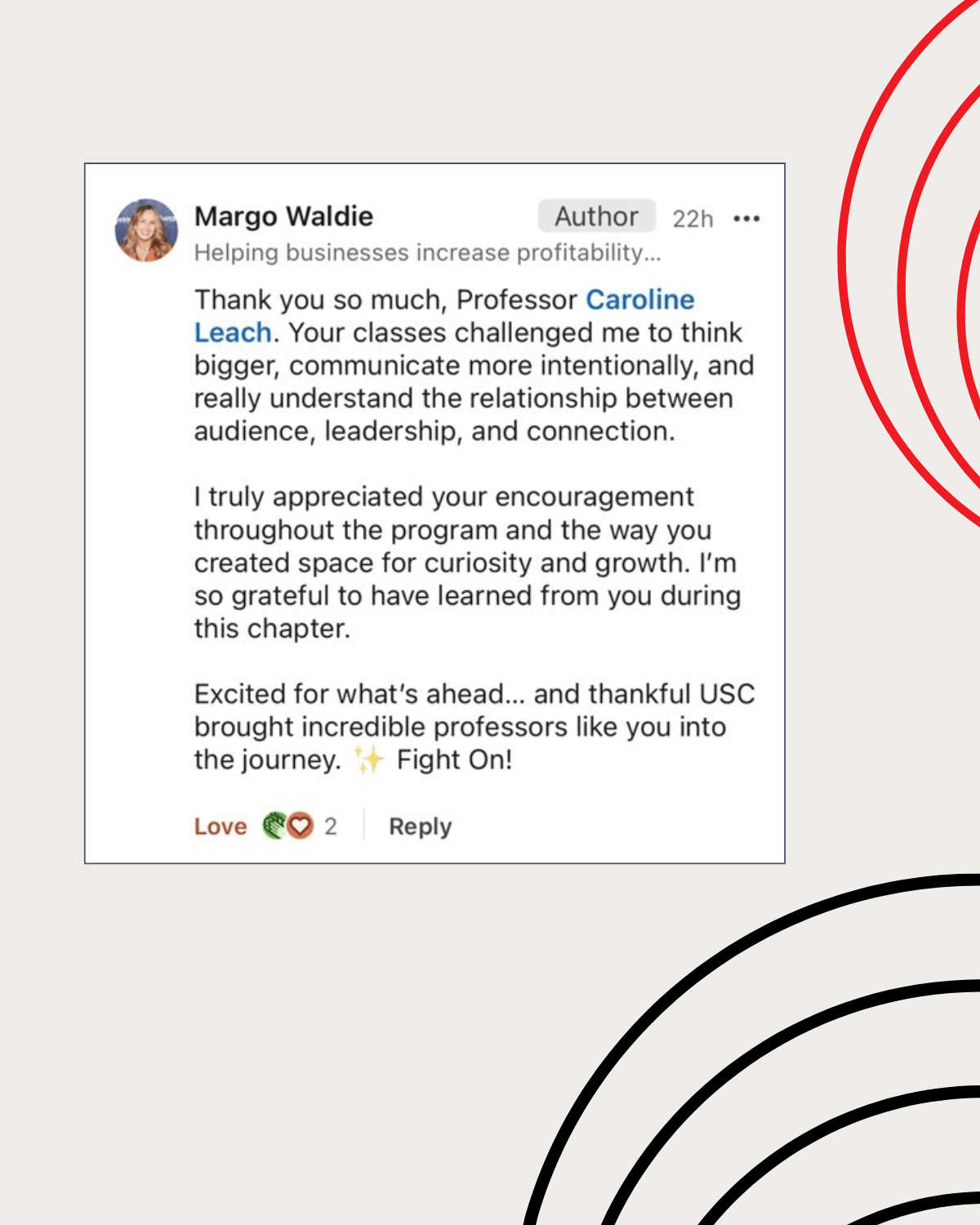
A student replied to my comment on her LinkedIn graduation post with words so thoughtful they made my week. Maybe even my whole year.
Thank you, Margo Waldie.
My biggest takeaway from this year:
Speaking up is more than participation.
It’s leadership.
What’s something a younger colleague or student taught you this year?
by Caroline Leach | Feb 16, 2025 | Careers, Leadership

Pings. Dings. Rings.
Our work days are overflowing with distractions.
In a busy environment, how can you increase your executive presence?
By doing the opposite.
By releasing the pull of technology.
By being fully PRESENT with people.
Being present is a topic Tom Larsen and I explored last fall in a talk at the UCLA Anderson School of Management.
Tom leads the EMBA Career Strategy & Development Team, and I’m an executive coach for students in the program.
Executive presence is about a feedback loop:
1️⃣ PLANNING: how do you want to show up?
2️⃣ EXECUTION: how are you showing up?
3️⃣ REFLECTION: how did you show up?
4️⃣ IMPROVE: what do you want to change?
Being present is part of the planning process. It’s being deliberate and deciding in advance how you want to show up.
Tom shared a story about a senior executive he’s coaching. This leader sets simple rules for how they require their team to show up in board meetings: no phones, no computers, and only the paper they need to engage in the meeting. Instead, this leader encourages the team to observe how other leaders and board members interact with each other.
Try these tips in your next video call or in-person meeting:
- Silence your phone.
- Put your phone away.
- Maintain eye contact.
- Sit or stand up straight.
- Ask clarifying questions.
Make it just you and the person or people you’re meeting with in the moment.
Put everything else aside. Just be there.
If unrelated thoughts pop into your mind, jot them down for later.
How do you also handle the reality that business moves quickly and you want to be responsive to your colleagues?
Check messages before and after meetings. Build in a few minutes between meetings, by scheduling them for 25 minutes instead of 30.
Better yet, do a calendar audit and decline meetings you don’t need to attend.
Do I always follow my own advice?
Not as often as I’d like.
But think about a meeting where you and your colleagues were fully present with each other.
How did the quality of your discussions and decisions differ from meetings where you and others were distracted?
What are your strategies for being fully present with people?



Recent Comments