by Caroline Leach | Aug 7, 2026 | Change, Communication, Leadership, Learning
Photography didn’t kill painting.
It created Impressionism.
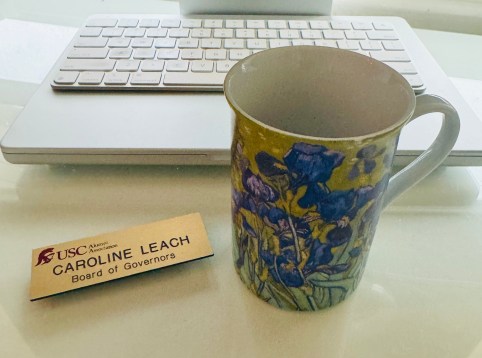
I was reminded of that during a visit to USC this season as an emerita member of the Alumni Association Board of Governors.
As a student in one of my USC Annenberg classes years ago, we studied how technology disrupted art over time.
Before photography emerged in the 1800s, artists tried to accurately mirror real life in their paintings.
Then cameras arrived.
Suddenly, photographs could capture reality better than paintings ever could.
So some artists stopped competing with the technology.
Instead, they created something technology could not replicate.
Emotion. Interpretation. Perspective.
We now know them as the Impressionists. Artists like Claude Monet, Edgar Degas, and Mary Cassatt.
There’s an important lesson for us in the age of AI.
Too many people are trying to out-machine the machine.
The better path is twofold:
1. Work with AI to improve outcomes.
2. Double down on what AI still cannot genuinely replicate: judgment, lived experience, discernment, empathy, perspective, and connection.
Technology rarely eliminates human expression.
It changes the medium.
It spurs evolution.
After all, video didn’t really kill the radio star either.
Radio evolved into podcasts, long-form conversation, and new kinds of storytelling.
Maybe the same will happen with writing, leadership, and communication.
The people who stand out won’t be the ones who sound the most polished.
They’ll be the ones who sound unmistakably human.
What’s one thing you do that AI can’t replicate?
by Caroline Leach | Jan 28, 2024 | Change, Learning

How do you learn to do something new?
Not by thinking, planning, or strategizing.
Instead, we learn simply by doing the new thing.
We learn by being okay feeling uncomfortable and awkward.
We learn by experimenting and having a beginner’s mindset.
Over the weekend, I was reminded of this.
One of my new endeavors for the year is taking adult ballet classes.
It’s been decades since I studied dance almost daily as a teen.
My mind remembers, but my body needs to re-learn how to do the steps.
Our instructor told the packed classroom at the outset, “the way to learn to dance … is to dance.”
So simple. Yet maybe it’s not the first thought when we start something new.
It could be anything new, whether it’s leading, marketing, designing, or something else.
For those who follow me, you know I’m learning to speak Spanish.
This year I’m also learning more about AI. I’m curious about how to better apply it to my work communicating, coaching, and leading.
One of the cool new LinkedIn tools is “rewrite with AI.” So this post appears in two versions, A and B. What resonates with you in each post and why? Drop a comment and let me know. 👇
This is Version A, written by me.
_____________________________
This is Version B, rewritten with AI.
How do you learn to do something new? Not by overthinking, but by simply doing. We learn by embracing the discomfort of being a beginner and experimenting with a beginner’s mindset. This weekend, I was reminded of this while taking adult ballet classes. Though it’s been decades since I last danced daily, my instructor reminded us that “the way to learn to dance…is to dance.” It’s a simple concept, yet one we often overlook when starting something new. Whether it’s learning a new language like Spanish or exploring the possibilities of AI, the key is to take action and learn by doing. So what new skill are you looking to tackle this year? Share in the comments below.
__________
P.S. One of the most fascinating learnings from this “rewrite with AI” experiment? I did it 3 times as I made slight edits to my post, and each time the rewrite was fairly different. Trying to decide what to make of that.
by Caroline Leach | Dec 28, 2023 | Change, Work/Life

How was your 2023? What are your hopes for 2024?
Here’s a fun and easy exercise to consider both. It’s called “The Wheel of Life,” from the the Co-Active Training Institute.
Pick a number between 1 and 10 for your satisfaction in these areas of your life (1 is the lowest and closest to the center of the wheel; 10 is the highest and closest to the outer edge of the wheel):
- Career
- Family and friends
- Significant other
- Fun and recreation
- Health
- Money
- Personal growth
- Physical environment
Feel free to modify the categories if you like.
Each category is like a wedge or a slice of pie in the wheel.
Plot your numbers around the wheel and then connect the dots.
The purpose? To see how smooth or bumpy your ride of life is.
The bigger the variation in numbers among categories, the bumpier the ride.
You can also use this to reflect on:
- What’s going well in your life?
- What would you like to improve?
- What actions will increase your satisfaction?
The wheel of life is one of the first exercises I learned in coach training at CTI.
It was fun to revisit it today with year-end reflection and year-ahead planning.
What are your reflection and planning rituals? Would love to know in a comment!



Recent Comments