by Caroline Leach | Aug 22, 2026 | Communication, Leadership

Great communicators don’t just speak well.
They make people feel remembered.
Last week at a university social event, someone I hadn’t seen in four years walked over to say hello.
We don’t know each other especially well.
Yet she remembered my name. She remembered my connection to USC Annenberg. She remembered that my husband Kevin owns and operates a restaurant.
She welcomed my guest into the conversation, shared what she was working on, and was genuinely interested in what everyone else was doing.
It would have been easy for her to stay with the people she already knew.
Instead, she walked across the room.
I’ve thought about that interaction ever since.
As someone who coaches leaders on communication, I spend a lot of time thinking about presentations, conversations, and the words we choose.
Last week reminded me that communication is also about making people feel seen.
↳ Walking across the room.
↳ Remembering something about someone’s life.
↳ Asking a thoughtful question.
↳ Including someone new in the conversation.
↳ Reconnecting, even after years have passed.
The most memorable people are often the ones who make other people feel remembered.
I’m taking that lesson with me.
The next time I’m at an event, I plan to be a little quicker to walk across the room, say hello, and reconnect.
Who’s someone you’ll never forget because they made you feel remembered?
by Caroline Leach | Aug 12, 2026 | Communication, Leadership

Some people think before they talk.
Others think by talking.
As an executive coach, I’ve learned that not everyone processes information the same way. I wish I was more aware of these differences much earlier in my career.
Extraverts often process information out loud.
↳ As they’re speaking, they’re sorting through ideas, testing assumptions, and working toward a conclusion in real time.
↳ The audience gets a front-row seat to the thinking process.
The challenge?
People sometimes mistake thinking out loud for uncertainty, indecision, or lack of preparation.
In reality, they’re often watching someone work through a problem in real time.
Introverts often process internally first.
↳ By the time they speak, their thoughts are frequently more refined and organized.
↳ The tradeoff is that the conversation may have already moved on before they’re ready to contribute.
Neither approach is better.
They’re simply different ways of processing information.
As a leader, it’s worth recognizing both styles.
Be sure to create space for people who need:
↳ To think out loud.
↳ Time to think before they speak.
And if you’re talking to think, make sure to tell people you’re thinking out loud.
That one sentence can prevent a lot of confusion.
by Caroline Leach | Aug 11, 2026 | Communication, Leadership

Early in my career, I watched people leave meetings in tears.
Then it was my turn.
Before I discovered corporate communications and executive coaching, I bought hardware for satellites in the aerospace industry.
Every few months, the director of procurement held something called the triannual review.
Each subcontracts administrator had to present the status of their contracts, explain risks, and answer questions in front of managers and peers.
These meetings had a reputation.
People got grilled about budget overruns, schedule slips, and quality issues.
Some froze.
Some rambled.
Some never recovered once the questioning started.
I had no interest in becoming the next cautionary tale.
Before it was my turn to present, I remember sitting in those meetings, watching the director work his way around the room, and wondering whether today would be the day I got called out.
So I watched the people who handled these meetings well.
What surprised me was they didn’t have perfect contracts to report on.
They had problems just like everyone else.
The difference was they knew their business inside and out.
They prepared deeply.
And once the meeting started, they stopped trying to follow a script.
When the director challenged them, they didn’t panic.
↳ They stayed calm.
↳ Answered the question and shared the facts.
↳ Then returned to the point they wanted to make.
Watching them taught me one of the most valuable communication lessons of my career:
The goal of preparation isn’t memorization.
It’s freedom.
When you know your material well enough, you don’t need to cling to a script.
↳ You can listen.
↳ You can think.
↳ You can respond.
Preparation creates presence.
It gives you the confidence to stay calm when you’re put on the spot.
It gives you the flexibility to communicate clearly when the conversation goes somewhere you didn’t expect.
Looking back, I still don’t believe fear is an effective management strategy.
It may reveal who can perform under pressure.
But it doesn’t necessarily help people solve problems.
by Caroline Leach | Aug 10, 2026 | Communication, Executive Communication, Leadership

One of the easiest ways to sound more confident:
stop explaining after you’ve made the point.
We’ve all done it.
You’re answering a question in a meeting. Somewhere along the way you realize you’ve gone from making a point to circling around it.
The instinct is to keep talking until you find your way back.
This is why it’s so important to read the room while you’re speaking.
To assess body language and adjust accordingly.
Are people looking away? Starting to fidget?
These are your cues to wrap up. Immediately.
Years ago, I joined a board meeting to give an update on a timely topic.
No slides. Just a brief overview and responding to board member questions.
And while I was speaking, I had the thought:
“That’s plenty of information. Time to stop talking.”
In retrospect, I should have stopped a few sentences earlier.
Because if people have questions, they’ll ask.
And board members love to ask questions.
That’s their job.
So make sure there’s time and space for that.
Stop talking sooner than you’re ready.
Clarity doesn’t always come from saying more.
Sometimes it comes from stopping, thinking, and saying less.
What’s your cue that it’s time to stop talking?
by Caroline Leach | Aug 7, 2026 | Change, Communication, Leadership, Learning
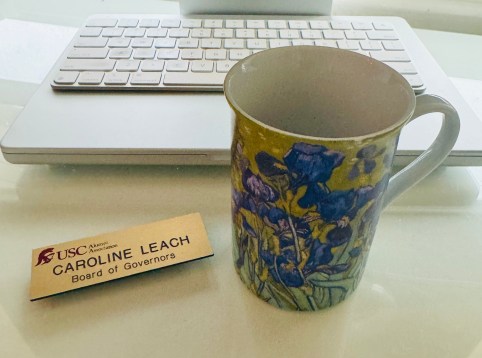
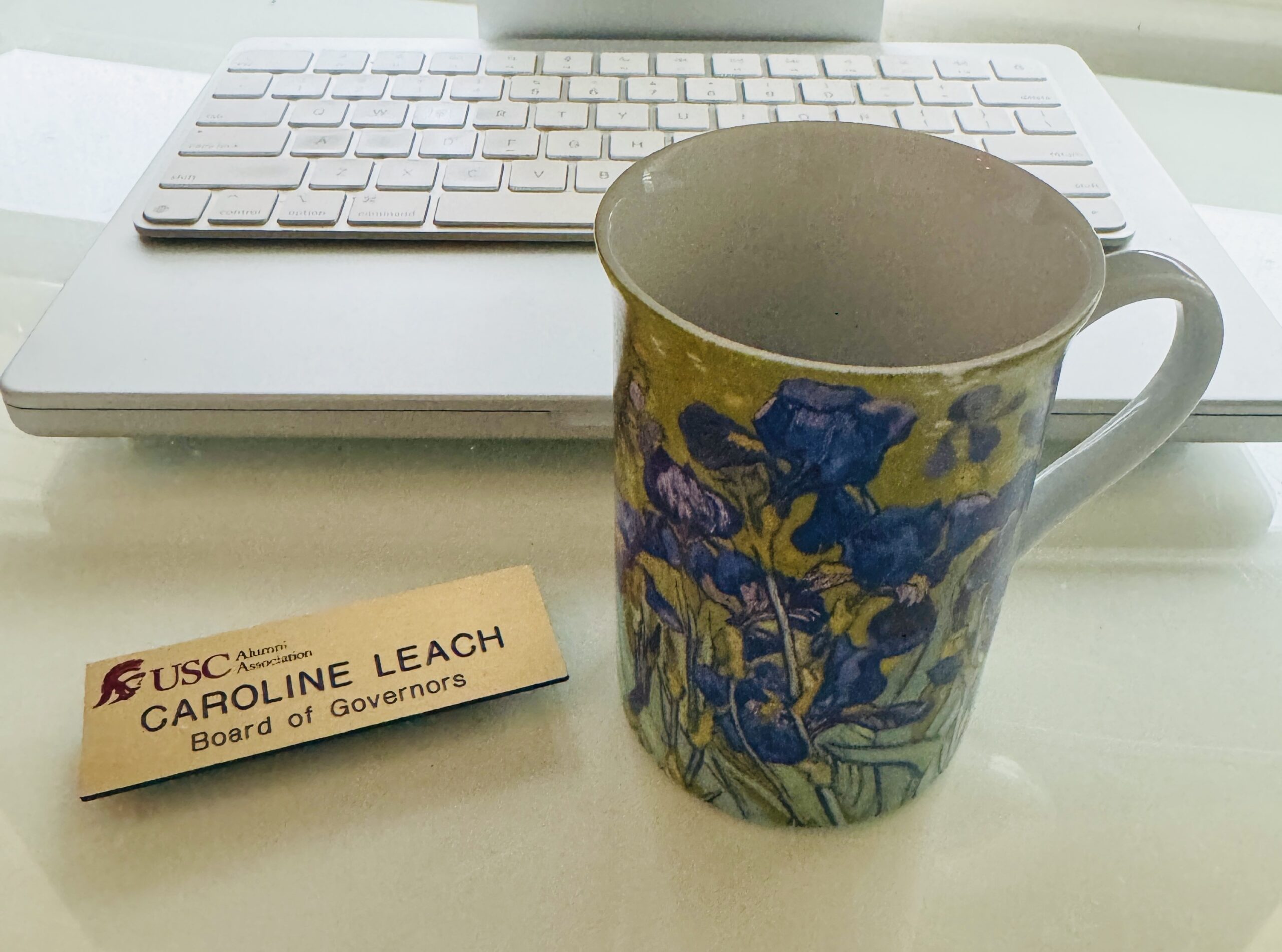
Photography didn’t kill painting.
It created Impressionism.
I was reminded of that during a visit to USC this season as an emerita member of the Alumni Association Board of Governors.
As a student in one of my USC Annenberg classes years ago, we studied how technology disrupted art over time.
Before photography emerged in the 1800s, artists tried to accurately mirror real life in their paintings.
Then cameras arrived.
Suddenly, photographs could capture reality better than paintings ever could.
So some artists stopped competing with the technology.
Instead, they created something technology could not replicate.
Emotion. Interpretation. Perspective.
We now know them as the Impressionists. Artists like Claude Monet, Edgar Degas, and Mary Cassatt.
There’s an important lesson for us in the age of AI.
Too many people are trying to out-machine the machine.
The better path is twofold:
1. Work with AI to improve outcomes.
2. Double down on what AI still cannot genuinely replicate: judgment, lived experience, discernment, empathy, perspective, and connection.
Technology rarely eliminates human expression.
It changes the medium.
It spurs evolution.
After all, video didn’t really kill the radio star either.
Radio evolved into podcasts, long-form conversation, and new kinds of storytelling.
Maybe the same will happen with writing, leadership, and communication.
The people who stand out won’t be the ones who sound the most polished.
They’ll be the ones who sound unmistakably human.
What’s one thing you do that AI can’t replicate?
by Caroline Leach | Aug 5, 2026 | Careers, Communication, Executive Communication, Leadership

Most people communicate worse under pressure.
Not because they lack expertise.
Because their attention turns inward.
They start thinking:
↳ How do I sound?
↳ Am I answering correctly?
↳ What if I don’t know enough?
↳ How am I being perceived?
And the pressure compounds quickly.
Working with and coaching senior leaders over the years, I’ve noticed:
The people who communicate best in the moment aren’t the most scripted.
They make a different shift:
from “me” → to “you.”
Instead of focusing on themselves, they focus on:
↳ What problem are we solving?
↳ What would actually help here?
↳ What does this audience need right now?
↳ How can I make this conversation more useful?
This week I’m speaking with MBA students in Singapore about corporate governance and board resumes.
I’ve prepared, of course.
But the most valuable moments won’t come from polished answers.
↳ They’ll come from the discussion.
↳ The questions students are really asking.
↳ The ability to stay present and listen carefully.
In high-pressure conversations, focus on what the audience needs.
How do you shift your focus outward when the pressure is on?
by Caroline Leach | Aug 3, 2026 | Careers, Communication, Leadership

I thought I was teaching my students this year.
Turns out, they were teaching me.
Congratulations to the USC graduates who celebrated commencement this spring!
This milestone lends itself to advice I might give to the graduates.
Instead, I’ve been reflecting on what I learned from my students this year in the USC MS in Digital Media Management at the Annenberg School for Communication and Journalism.
One lesson came through again and again:
Speak up.
In my Digital Media Leadership class, I started each session with a roll call question tied to the week’s topic. (Hat tip to program director Joseph Itaya.)
So many hands went up that roll call practically ran itself.
The students showed incredible initiative. They spoke up. And it changed the energy of our class every week.
They spoke up in discussions.
In breakout sessions and presentations.
In thoughtful discussions in class.
And in the messages some of them wrote to me at the end of the semester, which I added to a happy file I keep for difficult days.
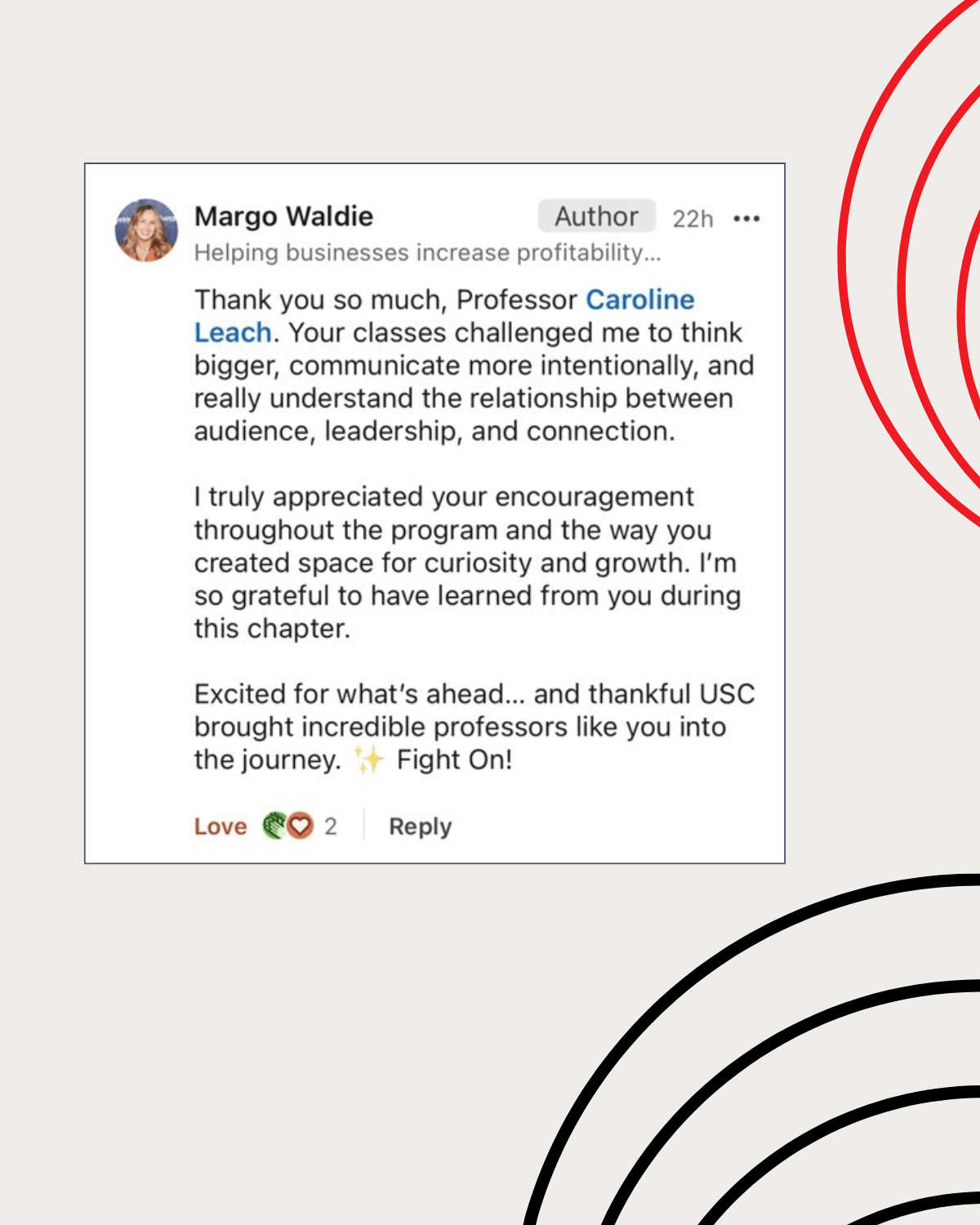
One message in particular stayed with me.
A student replied to my comment on her LinkedIn graduation post with words so thoughtful they made my week. Maybe even my whole year.
Thank you, Margo Waldie.
My biggest takeaway from this year:
Speaking up is more than participation.
It’s leadership.
What’s something a younger colleague or student taught you this year?
by Caroline Leach | Jul 21, 2026 | Social Media

Most people prepare answers for meetings.
Great leaders anticipate questions.
A habit I developed working with C-suite leaders:
Before any interaction, I prep for 3 to 5 likely questions.
Here’s what I consider:
↳ What’s top of mind for them right now?
↳ What are the key priorities of the business?
↳ What are they likely to ask?
And just as important:
↳ What have they challenged before?
↳ Where do they usually push?
↳ What matters most to them?
Because in high-stakes moments, you’re not evaluated on answers alone.
You’re evaluated on how you think.
That got tested earlier in my career.
First week at a new company.
The President’s assistant called:
“He wants to meet. Right now.”
I asked if there was a topic.
“No.”
30 seconds on the elevator.
No context. No idea what was coming.
So I defaulted to the one thing I could control:
Reflecting on what questions he might ask.
I walked in.
He dropped the print publication on the desk.
First question:
“Why do we need this?”
In that moment, I realized:
This wasn’t about print.
It was a test.
↳ Could I stay calm?
↳ Think clearly?
↳ Respond with intention?
That moment shaped everything that followed.
He stopped testing.
He started trusting.
Five years later, as he prepared to leave,
he came to my office to practice his farewell speech.
Even then, his focus was on the team.
How to lift them up.
How to position them.
How to leave them better.
That stayed with me.
If you want to communicate better under pressure:
Don’t just prepare answers.
Anticipate the questions.
What questions do you prepare for ahead of big meetings?
by Caroline Leach | Jul 13, 2026 | Communication, Leadership

Waiting to feel ready is costing you more than you think.
Especially when it matters most.
Years ago, an EVP asked for my thoughts on a communications issue.
I said I’d think about it and follow up.
Fair, right?
After the meeting, my manager pulled me aside.
“When a senior leader asks you a question, they expect a point of view in the moment.”
That stuck.
Because waiting has a cost:
1. You don’t come across as strategic
2. You get overlooked for bigger opportunities
3. And the team misses what you could have added
So why do we hold back?
↳ We second-guess our thinking
↳ We don’t have a perfect answer
↳ We assume everyone else is more certain than we are
(They’re not.)
Here’s what works instead:
Say this:
“Based on what you’ve shared, my initial thought is we should … .”
Add a relevant example.
Then close with:
“I’ll follow up with more detail this afternoon.”
You don’t need a perfect answer.
You need a point of view.
What do you say when you don’t have a fully formed answer?
by Caroline Leach | Jul 1, 2026 | Communication, Leadership

Most updates tell you what happened.
Very few explain why it matters.
Wrapping up spring semester teaching at the USC Annenberg School for Communication and Journalism brought this back again.
In strategic planning, everything comes down to one question:
What problem are we solving?
That’s where most updates fall short.
An operational update sounds like this:
“We launched the campaign, finalized the assets, and engagement is up 12% week over week.”
Clear. Efficient.
And incomplete.
A strategic update sounds like this:
“We’re addressing a drop in engagement among busy parents of children under 10. The campaign launched last week is designed to re-engage that group. Early signals are encouraging, with engagement up 12% week over week.”
Same work.
Different level of thinking.
The shift:
From activity → PURPOSE
From reporting → INTERPRETATION
From what happened → WHY IT MATTERS
If you want to be seen as more strategic, start here:
Anchor every update in the problem you’re solving. And how your work moves it forward.
Try this on your next update:
How is your latest work actually addressing the problem?






Recent Comments